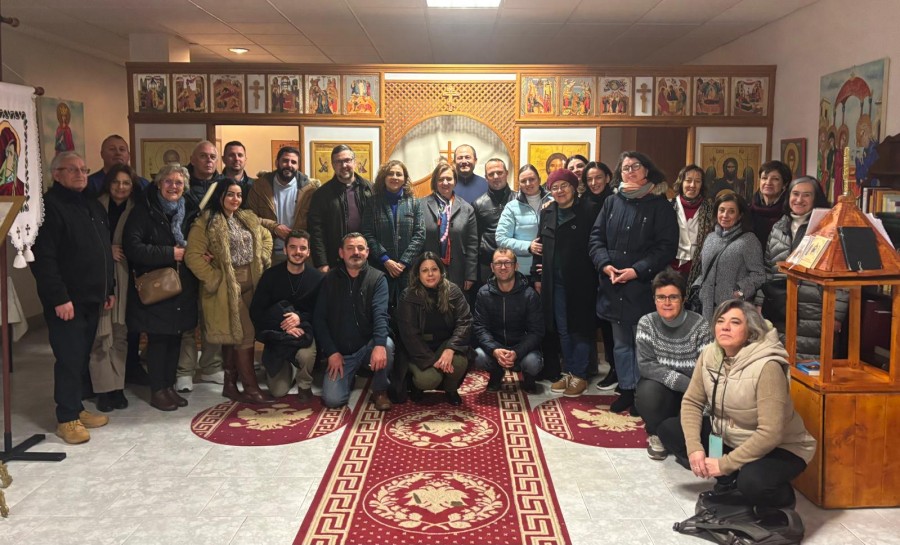
December 3rd
December 2
Word of life
Taken into exile in Babylon, the people of Israel have lost everything: their land, their king, the temple, and with it the possibility of worshipping their God, which had driven them to leave Egypt in the past. And then, the voice of a prophet makes a startling announcement: it is time to return home. Once again, God will intervene with power and lead the Israelites back across the desert to Jerusalem. And all the peoples of the earth will witness this wondrous event: «The ends of the earth will see the salvation of our God.» Today, too, the news is filled with alarming reports: people left without work, health, security, or dignity; young people whose futures are threatened by war and the poverty caused by climate change in their countries; peoples who no longer have land, peace, or freedom. A tragic scenario affects the entire planet, leaving us breathless and darkening the horizon. Who will save us from the destruction of all that we thought we possessed? Hope seems out of place. And yet, the prophet's announcement is also for us: "The ends of the earth will see the salvation of our God." His words reveal God's action in personal and collective history and invite us to open our eyes to the signs of this plan of salvation. In fact, it is already at work in the educational passion of a teacher, in the honesty of a businessperson, in the integrity of an administrator, in the fidelity of spouses, in the embrace of a child, in the tenderness of a nurse, in the patience of a grandmother, in the courage of men and women who peacefully oppose crime, in the welcoming spirit of a community. "The ends of the earth will see the salvation of our God." Christmas is approaching. In the sign of the Child's unarmed innocence, we can recognize once again the patient and merciful presence of God in human history and bear witness to it with our countercultural decisions: «[…] in a world like ours, where there is much theorizing about struggle, the law of the strongest, the most cunning, and the most unscrupulous, and where sometimes everything seems paralyzed by materialism and selfishness, the answer is love of neighbor. This is the medicine that can restore health. […] It is like a gust of divine warmth that radiates and spreads, penetrating the relationships between one person and another, between one group and another, and gradually transforming society»[1]. As for the people of Israel, the time has also come for us to set out on our journey; This is a fitting opportunity to take a decisive step forward toward all those—young or old, poor or migrants, unemployed or homeless, sick or imprisoned—who await a gesture of care and closeness, a witness to the gentle yet effective presence of God's love in our midst. Today, the boundaries to which this message of hope must be carried are undoubtedly geographical, so often becoming walls or painful lines of war; but also cultural and existential. Furthermore, an effective contribution to overcoming aggression, loneliness, and marginalization can come from digital communities, embodied in many cases by young people. As the Congolese poet Henri Boukoulou writes: «Oh, divine hope! Behold, in the desperate sob of the wind, the first lines of the most beautiful love poem are sketched. And tomorrow is hope!»[2]. Letizia Magri and the Word of Life team [1] C. Lubich, Word of Life of May 1985: Words of Life/1 (1943-1990) (ed. F. Ciardi), Ciudad Nueva, Madrid 2020, pp. 339-340.[2] Cf. Aa.Vv., Poeti Africani Anti-Apartheid, I vol., Edizioni Milano, 2003.
A hope without borders
Faced with global challenges, the tragic scenarios affecting the planet, and the news that reaches us, it seems as if everything conspires to steal our breath, darkening the horizon. Hope appears as a fragile commodity, almost a mirage. Therefore, it seems natural to ask this question: can we still hope for a better future for humanity, or are we condemned to resignation? In this situation, the thoughts of the German philosopher Ernst Bloch (1885-1977) can help us: “Hope is not a passive illusion, but a 'dream forward,' an active principle that anticipates what has not yet occurred. It is linked to the idea that the future is open and malleable, not predetermined‘[1]. Thus, each of us ’can continue to hope,” like someone daydreaming. If we know how to look closely, we can glimpse the dawn of a new awakening that is already here. We see it in a teacher's passion for education, in an entrepreneur's honesty, in the integrity of someone who manages with respect, in a couple's fidelity, in a child's embrace, in a nurse's care, in a grandmother's patience, in the courage of someone who peacefully resists violence, in a community's welcoming spirit. Even more telling of hope is the testimony of children in war zones, where they find safe spaces to safeguard the future. This is evident in the drawings created by the girls and boys participating in Save the Children's psychosocial support programs. Among pencils and colors emerge dreams of becoming doctors, writers, or fashion designers… These safe places where they gather offer them an environment to play, express themselves, and imagine a future beyond conflict. The artwork was released on World Mental Health Day, October 10, 2025, and testifies to the resilience of children in the face of war.[2] And no less importantly, we find hope in millions of people around the world—children, young people, adults, and the elderly—who, afflicted by serious illnesses, face with strength, tenacity, and resilience the challenge of overcoming this obstacle that life has placed in their path. How much courage and what a lesson in love for life these people offer us! These small, everyday signs remind us that hope is not an illusion, but a real force, born of love that radiates and is capable of transforming society step by step. Everyone thirsts for hope, both those close to us and those far away (physically, existentially, or culturally). This idea invites us not to remain still, but to take a step to bring hope to those who need it and have lost their sense of purpose. Let us approach them with a gesture of care, becoming neighbors, offering our love gently and freely. Many are waiting for it, and we are called to reach them all. As the Congolese poet Henri Boukoulou writes: “[…] Oh, divine hope! Behold, in the desperate sob of the wind, the first lines of the most beautiful love poem are being written. And tomorrow… is hope!”[3]. [1] Ernst Bloch (1885-1977), Das Prinzip Hoffnung (1954-1959) - «The Principle of Hope» (Spanish ed.).[2] https://www.cittanuova.it/multimedia/i-sogni-dei-bambini-di-gaza-tra-guerra-e-colori[3] Cf. AA.VV. Poeti Africani Anti-Apartheid, I vol., Edizioni dell'Arco, Milano, 2003.
The ends of the earth will see the salvation of our God
Jesus was born for all peoples
December 1st
November 30th
November 29
Artisans of hope

To give life to parishes so that they may be a “community of hope” in the Church and humanity.