Get up again, without fear
«Only those who fall can rise again,» says a proverb. An example that conveys both tenderness and courage is that of children in the early stages of their development. What willpower they possess in those first tentative steps, rising each time with determination, until they gain confidence and begin with increasingly sure movements… the path of life! As we grow, amidst challenges and difficulties, getting up becomes increasingly difficult. Life’s trials weigh heavily on us, and the fear of losing our sense of security (in encounters with those who are different or don’t think like us) holds us back. Willpower alone is not always enough, nor even the sincere desire to be consistent with our values and choices. In these difficult moments, being able to count on a helping hand can give us the impetus to begin again without fear and, in the depths of our consciousness, create an authentic silence capable of “rebuilding” ourselves inwardly. As Chiara Lubich says: «Who doesn’t go through trials?» This takes on the character of failure, poverty, depression, doubt, temptation […]. The materialistic and individualistic society that surrounds us, with its wars, violence, and injustices, is also frightening….“ Chiara demonstrated this with her own life: it is precisely in these moments of darkness and weariness that it is most important to find the strength to ”start again,“ first and foremost within ourselves, with the confidence that ”you can still hope for everything“[1]. This is what happened to Emilia of the Holy Land. She works as the director of a government sector alongside Jews, Christians, Muslims, and Druze. After October 7, 2023, she understands that love is the only possible response to this great pain and commits herself to loving all those around her, above all through listening, so that she can welcome the other into her heart. To listen with love and humility, and to understand what the other has to say, whether Arab or Jewish. Thus, with a large number of their colleagues, they have become so open with one another that they can speak freely about the situation, and this has given courage to other colleagues to express their fears and pain, keeping the group united and maintaining peace.[2] There are many stories of wounded communities that do not give up, that find day after day, living the reciprocity of sharing everything, the strength to believe that hatred cannot have the last word. Even if we are not the ones who see the fruits of our commitment, every time we get up we will contribute to forming ”new men,« because—as Bonhoeffer said from prison shortly before his death—: »For those who are responsible, the ultimate question is not how I heroically get through this, but: what will life be like for the next generation?“ [1] ”Restarting” Gen Rosso[2] Experience explained at the One Human Family interfaith congress in June 2024 in Castel Gandolfo, Italy
March 2
The General Assembly of the Focolare begins

PRESS RELEASE – February 27, 2026 From March 1 to 21, 320 representatives from Focolare Movement communities around the world will participate in the fourth General Assembly since the death of its founder, Chiara Lubich. The Assembly will elect new members to the governing body and approve the programmatic guidelines for the next five years. According to Article 1 of the Regulations of the Focolare Movement's General Assembly, participants will experience this gathering in profound communion, to strengthen unity throughout the Movement and guide it toward the fulfillment of its objectives. The Assembly is indeed one of the most significant events for the Focolare Movement and is held every five years, as established by the Decree of the Dicastery for the Laity, Family and Life (2021). It will take place at the Mariapolis Center in Castel Gandolfo (Rome), where 320 participants—including approximately 50 observers—are arriving from different countries, cultures, and ecclesial and religious backgrounds. They are united by their adherence to the spirit and values of the Movement founded by Chiara Lubich (1920-2008) and recognized by the Catholic Church as a private, universal association of pontifical right. The Assembly program will begin with a three-day spiritual retreat. On March 5, the current president, Margaret Karram, will present her end-of-term report, accompanied by some reflections from the co-president, Jesús Morán. In the following days, plenary sessions will alternate with work in 30 groups, dedicated to exploring the themes received from Focolare communities worldwide. The arguments guiding this work will focus on how to implement the charism, that is, creating relationships of fraternity and unity in the current global context through a commitment to peace and social justice, dialogue in a polarized world, the responsible use of technology, dialogue as a privileged instrument among Christian Churches and with people of different faiths and non-religious beliefs, integral ecology, and participatory governance. One of the themes will also be the transmission of the Focolare charism to future generations of the Movement. In addition, debate sessions are planned on proposed amendments to the General Statutes and the Regulations of the Movement's various branches. The day of March 12 will be dedicated to the election of the president and co-president, positions which—according to the Focolare General Statutes—must be confirmed by the Holy See. Subsequently, on March 15, the Assembly will elect the General Councilors, thus completing the formation of the Movement's new government. Toward the General Assembly: A Global Process. To prepare for this Assembly, Focolare communities in 150 countries participated in an extensive process of listening and synodal discernment, contributing ideas and priorities for the future. This resulted in hundreds of contributions on key issues and on the challenges the Movement is facing internally and in the global context. The territorial communities also expressed their preferences regarding the candidates for the Movement's government. News and updates on the work of the Assembly will be available on the Focolare website and in upcoming press releases. Stefania Tanesini, Spokesperson, Focolare Movement, +39 338 5658244. Download the file.
March 1st
February 28th
The preparatory process for the 2026 General Assembly has concluded.
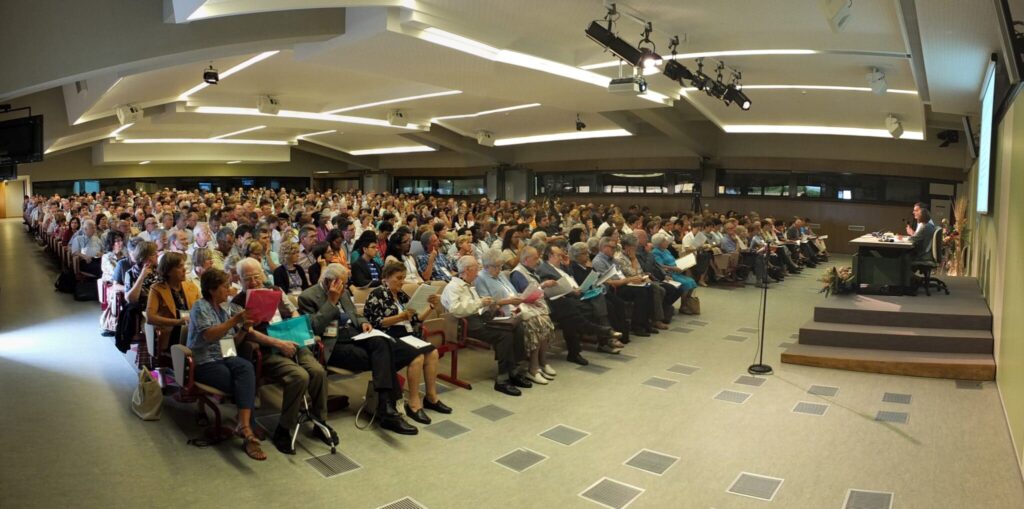
The pre-assembly itinerary that accompanied the preparation for the General Assembly of the Focolare Movement, which will be held from March 1 to 21, 2026 in Castel Gandolfo (Italy), has ended.